
-
Subjects / Themes included:
Impact of food waste on the environment, Land and Resource use, Food transportation from production to consumption, Economy, Healthy food as a nutrition, National and global inequalities, social behavior around food waste, Healthy vs Unhealthy food, social interaction
-
Language:
English

-
Can be used in project-based learning (out of subject teaching):
Yes
-
Hours required (total):
45 to 60 minutes of playing
-
Number of sessions:
Minimum 1
-
Developed & tested by:
Michala Hvidt Breengaard, Mukti R. Chapagain, Subash Rana & Lis Zacho and + 6th grade pupils
Introduction
Why is this topic important?
This board game on food waste aims to increase knowledge about food waste as well as to translate knowledge into action. The game is educative in its way of informing about food waste and drawing attention to how social norms and individual behavior take part in the global problem of wasting food. In doing so, the game aims to bring knowledge and action closer together. The game is based on data from the Chorizo project about young people’s food behavior and attitudes as well as the social norms around food and food waste.
Food waste is a global problem but can have an impact on individual health and economy, environment (Climate) and global resources. Furthermore, food waste can be linked to social behavior around food, and social interaction between people as well as national and global inequalities. Food waste among consumers is a behavioral challenge with behavior being acquired and developed over time and influenced by various sorts of knowledge and skills as well as social norms and ideals. However, behavioral challenges can be addressed with proper action.
The school environment has a potential to influence pupils’ behavior and promote new good attitudes toward food waste. Lunch in school are eaten together with other pupils and social norms often play a crucial role in the pupils’ attitude toward eating or wasting their lunches. Furthermore, what is learned in the school environment in relation to lunch consumption might influence food consumption at home and vice versa. Parents’ knowledge, skills and attitudes toward food waste have an impact on children, in the same way, children play a crucial role in bringing food waste into the family.
To put food waste on the agenda in both the school and family setting, the game is structured around various themes related to food waste and its impact on individual and planetary health, environment and family economy. Based on the project findings, the game aims to promote the understanding and recognition of food waste in various settings and types of food. This includes:
– To make aware of social norms around food waste and their impacts.
– To educate about food waste from various angles (e.g. nutrition, climate, economy)
– To promote a dialogue about food and food waste among pupils as well as between parents and children
The game particularly focuses on school and home contexts, such as lunch-packs and eating with the family. The game is designed as an activity that can be carried out in the classroom among pupils and at home with the family – so called school-home learning tools. The game comes with questions, reflection and action cards.
Theory
What do we know from science?
The board game is built upon research into game-based learning. Research shows that games can provide a stronger motivation to engage in learning activities which are considered unattractive, e.g. reading textbooks or listening to presentations. Educative games seem effective in enabling involvement, responsibility, commitment and relevance in processes of learning. This learning potential applies to both physical and digital games. Learning about food waste is a subject that can benefit from gamification.
Findings from the CHORIZO project indicate a missing dialogue between children and parents as well as among pupils in relation to preference, choices and waste of lunch packs. Findings also show that the younger the pupils were, the more likely they were to eat what they brought from home or offered. Conversely, older pupils more often throw out their meals and lunch-packs. Young people´s attitude and motivation regarding the consumption or wasting their lunch-pack is influenced by peer groups and family. Pupils’ likelihood of discarding their lunch-pack is largely influenced by their perceptions, preferences, and expectation regarding taste, texture, and freshness of the food item. Furthermore, pupils’ individual interpretation of food quality plays a significant role. Pupils tend to be “selective and picky”, favoring sweet, salty and fatty food such as hot dog, pizza, chips, chocolate bars etc. over fruits and vegetables.
The findings show a vast potential in changing behaviour in a healthier direction. A widely used model within behavioral psychology that can help to understand the processes in behavioral change is the Motivation Opportunity Ability (MOA) framework. It is a rather universal theory that is applied in a lot of different areas from smoke cessation, drinking habits, organ donation, pension saving and eating habits etc. The MOA framework is about understanding the underlying mechanisms that lead to behavioural change, including the three components of Motivation, Opportunity and Ability.
Firstly, motivation is about the need to think that a specific action is important and that you need to feel motivation to perform a certain behaviour. If you do not agree that minimizing food waste is good, it will be hard for you to start wasting less. You can think about motivation as an inner voice telling you to perform a certain action from time to time. A kind of reminder, and of course the first step towards motivation is knowledge. If you know about the damage that food waste do to the climate or the amount of biological or financial resources that go wasted on the garbage bin it is much easier to feel motivated.
Secondly, there needs to be an opportunity in the surrounding environment for taking action. If you cannot get a “doggy-bag” in your favorite restaurant it will be difficult to bring leftovers back home for later consumption. And if your school canteen has a compulsory weighing of your plate waste at checkout it will be much easier for the school headmaster to follow the progress of food waste mitigation actions. So, a lot of opportunities have got to do with the environment. Think about the environment as “all that is out there” as the structures in which we live our lives. So, if the food environment is dominated by a lot of minimarkets selling only Ultra Processed Foods it will be difficult for you to increase your intake of fruit and vegetables.
Thirdly, you need to have the ability to perform a given kind of behaviour. If you do not know the difference between “best before” and “best by”, you are likely to end up wasting more food than is needed, keep in mind that shelf life and expiry dates are always determined by algorithms. That is, they are predicted based on mathematical models. Yogurt is a good example. It is made from milk but has a longer shelf life because it is fermented. When you ferment foods, you lower the pH by “handing over the control” to the good bacteria – the lactobacilli. When this happens, the bad bacteria cannot grow, and yogurt is still safe to eat past “best before” date after tests. And since growth of bad bacteria is normally followed by clear signs of deterioration, you can conduct tests of Look, Smell and Taste of the product. So, by knowing the basic principles of preservation of foods you can save a lot on your waste account. This is often referred to as food literacy.
Having covered the opportunities and the ability, the question remains, how do we best create learning? Traditionally, we would read books, count on a teacher to supervise and coach us and do some homework. But learning and curricular studies have come up with a range of alternative approaches. Gamification is one of them. Gamification is usually considered as entertainment and a pastime, but you can get really far with games, even when the purpose is to learn and create learning outcomes. So far, a research tradition has emerged on how best to use gamification as an active element in the learning process. Gamification can help increase the students’ motivation level, it can increase knowledge retention, and it can create engagement through social mechanisms such as competitions, challenges and rankings. And in the digital age, technology is of course one of the driving forces behind gamification. New screen types, fast processors and artificial intelligence are some of the technologies that have helped the development along. But despite the technological innovation, old fashioned non-digital versions such as board games has not become obsolete. On the contrary – physical games such as board games has got a revival over recent years. So why not apply the gamification track to the fight against food waste?
Learning goals
What will we learn?
The overall goal of the board-game is to create awareness and dialogue about food waste. The game does so by a mix of sharing knowledge and creating involved interaction between the players (young people (pupils) as well as their family). Through playing this game, the participants will:
- Gain knowledge about food and food waste in various contexts.
- Get an increasing understanding of how they themselves contribute to food waste in different settings.
- Learn about the social aspects (social norms) around food that cause wasting food behaviour as well as the possibilities of changing those norms.
Learn about various aspects of food waste and its impact on the environment and economy from an individual, societal and planetary perspective.
Learning process
How do we organise activities?
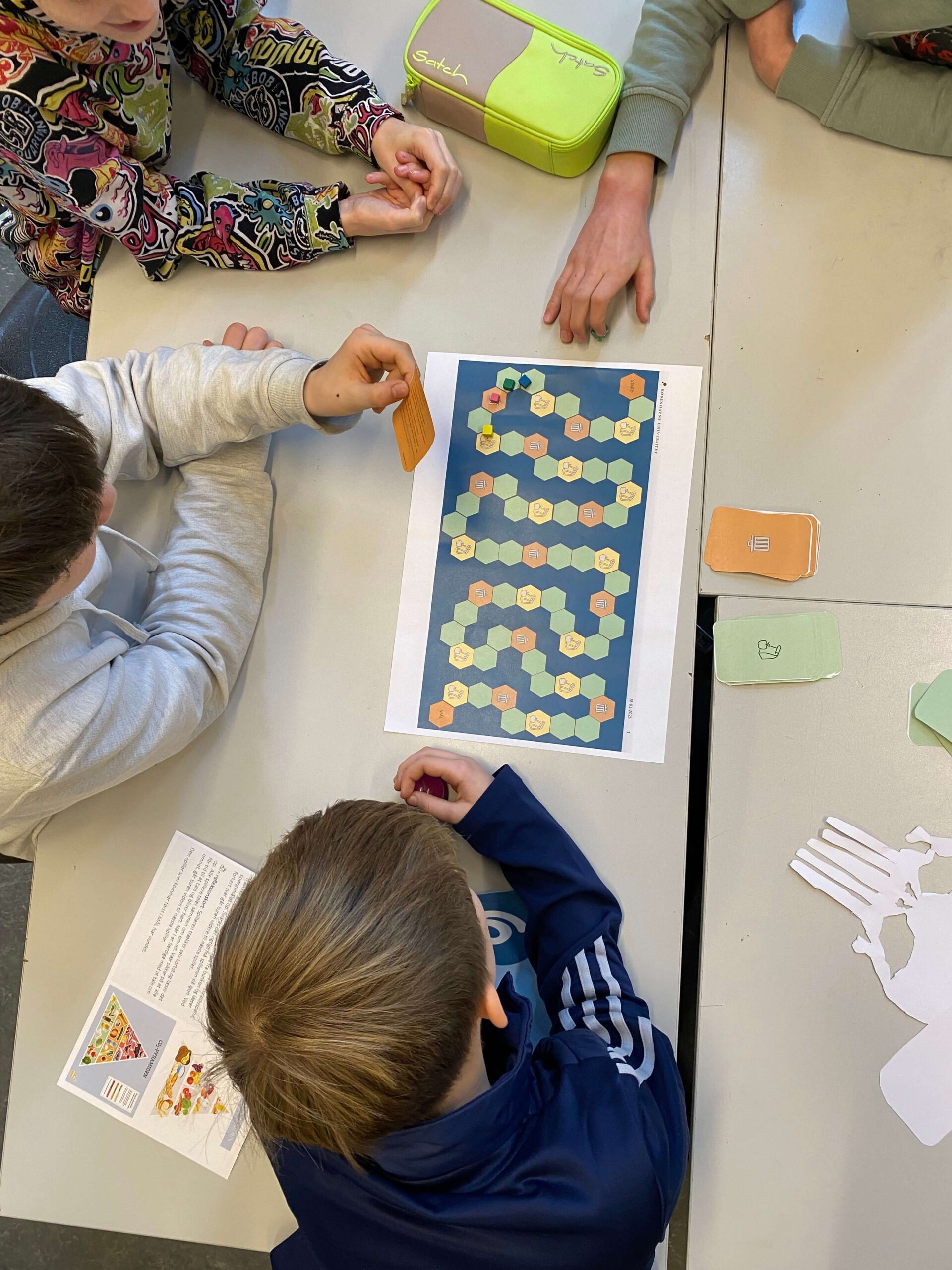
The board-game can be played in various settings such as in schools and home with different people. The game follows the basic principles of board games such as Ludo, where each player has different color tokens that they need to move from their starting point to the finishing area. The movement of the tokens is determined by rolling a single die.
 Action card
 Question card
 Reflection card
The board is played among 2-4 participants. Each player rolls the dice in their turn and moves the number shown on the dice. If a player lands on a space with an icon, a card is drawn from one of the two piles. There are three types of icons representing cards with corresponding colors.
The game is educative by informing and drawing attention to social behaviours regarding food waste and its impact on environment and economy at a individual, societal and planetary level. All the participants are encouraged to participate in reflection and discussion in a constructive way towards common solutions of reducing food waste.
Materials & facilities
What do we need for the activity?
The board game contains the following downloadable materials:
1. Instructions for Board Game
2. Game Board (Print in A3 size)
3. Reflections Cards (Print in color)
4. Question Cards (Print in color)
5. Action Cards (Print in color)
Tokens in different colors & dice to be purchased separately.
A digital version will eventually be developed to be played on KaHoot using a big screen.
Resources & links
Where can we learn more?
- Seasonal Calendar Plateform to Explore Seasonal Fruit and Vegetables in Europe
- LunchPack-ideas(Gi’ madpakken en hånd) Helpfull list of suggestion of the food item to make balanced lunch-pack based on 5 figure model
- Smag på overskuddet (Taste of surplus food) Materials to download to work with surplus food and prepare tasty meal.
- FredgeStiker Visual sticker for the fridge with “Eat me now” or “Save me for dinner”
- TasteGuide (Smaguiden) Visual guidance of the taste and taste matching of the food ingredients